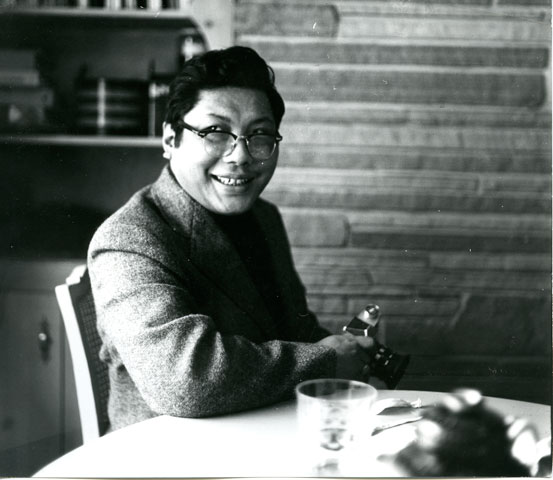
Picture of Chögyam Trungpa

Chögyam Trungpa

CTR Quote of the Week

A Quote for the 39th Anniversary of Trungpa Rinpoche’s Parinirvana (Death)

Due to technical difficulties, it was not possible to send this quote on April 4th. It is excerpted from a talk by Diana J. Mukpo, Trungpa Rinpoche’s wife, given at the consecration of the Geat Stupa at Drala Mountain Center in 2001. Lady Diana passed away in September of last year, and it seemed appropriate to offer something from her for the Parinirvana this year:

In the early 1970s, after Chogyam Trungpa Rinpoche and I moved to this country, we had two children within a short period of time. At that time, our domestic situation, or our family mandala, was not fully developed. I experienced a fair amount of hardship, because I was home alone quite a lot with two babies, and Rinopche was gone almost every evening. I sometimes complained to him, saying, “You need to come home in the evenings.” He would say, “I’m sorry but I have all these important things to do.” So it went, for quite some time. Finally, I decided to up the ante, so I said, “Don’t you love me?” I thought I was playing the ultimate card. Then he said, “Yes, I love you, but I will always love you second best. My first love will always be Jamgon Kongtrul. That is my guru, and that is the dharma. My first love will always be the dharma.”

In retrospect, as difficult as things sometimes were for me at that time, I understand what he was saying, and I’m so grateful that the dharma was always foremost in Rinpoche’s mind. At times Rinpoche could be sentimental about missing the physical embodiment of his teacher. However, the inner meaning was that his guru, Jamgon Kongtrul, was the embodiment of the dharma. My husband, Chogyam Trungpa Rinpoche, understood and accepted this fully, and the dharma became his manifestation and his reason for living altogether. The community of dharma practitioners that he created and his influence on Buddhism in the West altogether have their roots in this commitment to the dharma and his willingness to teach.

Presenting the dharma in North America in the early 1970s was quite a formidable task. Now, the ground is a little bit more tamed for presenting the teachings. People’s understanding of Eastern religion is a bit more sophisticated. When Rinpoche and I arrived in North America, it was in the middle of the hippie era, a cultural upheaval. There were few forms in place for the practice of the buddhadharma, and very few precedents – most of them not widely known – for how to relate to someone who is presenting the Buddhist teachings. There was very little ground to build on. But Rinpoche took great delight in the whole situation. There was never a moment of resentment, complaint or irritation. He was full of joy and enthusiasm about the openness of people he found in North America and about his ability to communicate and to teach people here.

Trungpa Rinpoche was the supreme example of right view, of taking the dharma to heart in every act.

From an unpublished talk by Diana J. Mukpo, August 12, 2001.

To listen to or view more than 550 talks by Chogyam Trungpa, visit the Chogyam Trungpa Digital Library.


Share Quote

Subscribe to

Quote of the week

Our newsletter

Making Friends with Fear

Fear is not necessarily problematic. It is like an attack of sneezing. It comes and goes. However, you have to study your fear. That is

Read More

First Thought

We have created layer after layer of security mechanisms in our lives. We are taught to consult authorities or experts about almost everything. If you

Read More

Four Season Haiku Tiger

SPRING Shifty fire Amber with coal I detect something in the jungle   SUMMER Tigers get good bath Fresh look of their coat Competes with

Read More

Self Hatred Falls Away

In meditation, the obstacle of self-hatred will fall away, by itself, when we have trust in ourselves. In that way, the experience of mindfulness can

Read More

An Unconditional Society

Here, we are not talking about meditative discipline as a revolutionary act, regarding our meditation group as a little fortress from which we can launch

Read More

Beyond Blah Blah Blah

Although we have established genuine friendship, camaraderie, and fellowship with our fellow meditators, we still might be looking for credentials and security. Belonging to certain

Read More

An Orchestra of Group Sanity

Basically, nobody can help the world without individual personal discipline. However, when hundreds of individuals personally commit themselves to developing themselves through the practice of

Read More

Setting a Trap for Monkey Mind

Awareness, or intelligence, is quite a different and separate category from the monkey mind. The intelligence or consciousness has less speed and does not carry

Read More

What is Monkey Mind?

The monkey-mind, or sem, is the intelligent state that relates with objects. It is fickle in nature, constantly moving, and this movement leaves impressions behind.

Read More

Experience the Gaps

In everyday life, we habitually try to conceal the gaps in our experience of mind and body. These gaps are a bit like an awkward

Read More

Joining the Victorious Ones

An empowerment, or abhsheka, is further sunrise, further East, further dawn of Vajrasattva, further Tai Tung (Great East). Abhisheka enables you to be among the

Read More

Royal Empowerment

A vajrayana empowerment is a kind of baptism or coronation. It is the coronation of the student as a would be king or queen. In

Read More

Transmission

Basically, transmission is the meeting of two minds. Understanding this is absolutely necessary. Otherwise, there is no way out and no way in–there is no

Read More