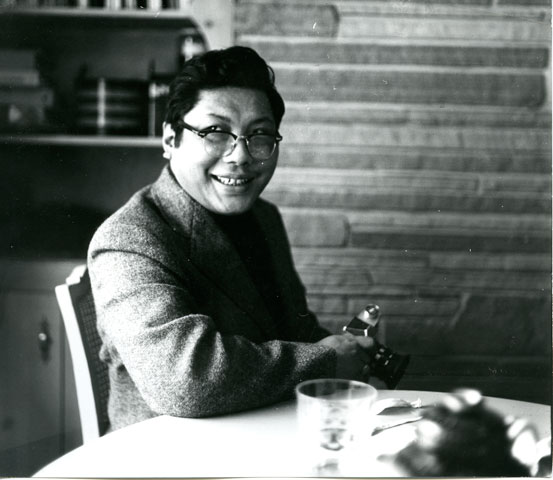
Picture of Chögyam Trungpa

Chögyam Trungpa

CTR Quote of the Week

A Quote for the 39th Anniversary of Trungpa Rinpoche’s Parinirvana (Death)

Due to technical difficulties, it was not possible to send this quote on April 4th. It is excerpted from a talk by Diana J. Mukpo, Trungpa Rinpoche’s wife, given at the consecration of the Geat Stupa at Drala Mountain Center in 2001. Lady Diana passed away in September of last year, and it seemed appropriate to offer something from her for the Parinirvana this year:

In the early 1970s, after Chogyam Trungpa Rinpoche and I moved to this country, we had two children within a short period of time. At that time, our domestic situation, or our family mandala, was not fully developed. I experienced a fair amount of hardship, because I was home alone quite a lot with two babies, and Rinopche was gone almost every evening. I sometimes complained to him, saying, “You need to come home in the evenings.” He would say, “I’m sorry but I have all these important things to do.” So it went, for quite some time. Finally, I decided to up the ante, so I said, “Don’t you love me?” I thought I was playing the ultimate card. Then he said, “Yes, I love you, but I will always love you second best. My first love will always be Jamgon Kongtrul. That is my guru, and that is the dharma. My first love will always be the dharma.”

In retrospect, as difficult as things sometimes were for me at that time, I understand what he was saying, and I’m so grateful that the dharma was always foremost in Rinpoche’s mind. At times Rinpoche could be sentimental about missing the physical embodiment of his teacher. However, the inner meaning was that his guru, Jamgon Kongtrul, was the embodiment of the dharma. My husband, Chogyam Trungpa Rinpoche, understood and accepted this fully, and the dharma became his manifestation and his reason for living altogether. The community of dharma practitioners that he created and his influence on Buddhism in the West altogether have their roots in this commitment to the dharma and his willingness to teach.

Presenting the dharma in North America in the early 1970s was quite a formidable task. Now, the ground is a little bit more tamed for presenting the teachings. People’s understanding of Eastern religion is a bit more sophisticated. When Rinpoche and I arrived in North America, it was in the middle of the hippie era, a cultural upheaval. There were few forms in place for the practice of the buddhadharma, and very few precedents – most of them not widely known – for how to relate to someone who is presenting the Buddhist teachings. There was very little ground to build on. But Rinpoche took great delight in the whole situation. There was never a moment of resentment, complaint or irritation. He was full of joy and enthusiasm about the openness of people he found in North America and about his ability to communicate and to teach people here.

Trungpa Rinpoche was the supreme example of right view, of taking the dharma to heart in every act.

From an unpublished talk by Diana J. Mukpo, August 12, 2001.

To listen to or view more than 550 talks by Chogyam Trungpa, visit the Chogyam Trungpa Digital Library.


Share Quote

Subscribe to

Quote of the week

Our newsletter

This Very Moment Is Everything

In the Buddhist tradition, supplication is not asking something of some divine principle that exists somewhere else–upstairs in the loft. Instead, supplication is the fundamental

Read More

The Charnel Ground

In the ordinary, usual world that we live in, there is always a charnel ground of some kind — where we try to catch each

Read More

All-Encompassing Friendship

The beginning point of buddha nature seems to be the development of maitri, which could be translated as “love,” “kindness,” or “a friendly attitude.” Having

Read More

Ordinary Suffering

Ordinary suffering is very genteel in a sense and very friendly. You are just suffering for the sake of suffering. There is confusion because of

Read More

Suffering of Suffering

An example of the suffering of suffering is that you have a bankruptcy, and on top of that, you are arrested by the police. You

Read More

Cosmic Suffering

The question of basic pain, or cosmic suffering, is not so much one of physical pain, but it is more like a basic ache, basic

Read More

Working with Our Resentment

Basically, the nature of samsara, or confusion altogether, is suffering. Samsara is a gigantic bag of confusion, lust, and aggression. We know that in America

Read More

Confidence Is There

If we want to present unconditional confidence to others, to help others appreciate this quality in themselves, we don’t have to be pedantic or heavy-handed.

Read More

Unconditionally Awake

The ordinary sense of confidence is confidence about something, which is conditional or qualified. But in this case, gentleness and softness give rise to an

Read More

The Spark within Us

Our opinions and attitudes about  ourselves are very important. We cannot ignore the slightest tendency to feel wretched, inadequate, or fundamentally distrustful of ourselves. Those

Read More

The Gaps in Confusion

Confusion cannot exist without the reinforcement of further confusion. So there is constant reinforcement of confusion, chain reactions being set up constantly. If you have

Read More

The Gaps within Karmic Situations

Understanding the psychological approach of karma is an essential thing. We might think that the karmic situation is entirely predestined, all the time. Dualistic fixation

Read More

Smile at Fear

Pain causes chaos, fear, and resentment, and we have to overcome that. It is an extremely simple logic. Once we can overcome pain, we discover

Read More

Don’t Jump the Gun

You have to develop yourself first; then you can begin to work with others. So don’t jump the gun. As a warrior, don’t put on

Read More