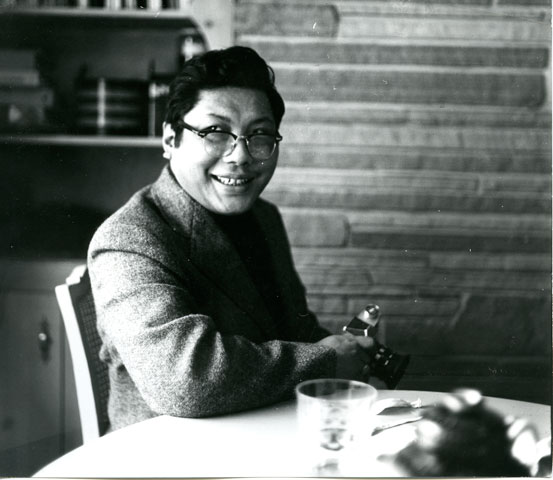
Picture of Chögyam Trungpa

Chögyam Trungpa

CTR Quote of the Week

What Do We Do with That?

Onto the disk of the autumn moon, clear and pure, you transplant a seed syllable. Cool blue rays of the seed syllable radiate immense, cooling compassion beyond the limits of space, which fulfill the needs and desires of sentient beings. They radiate basic warmth, so that the confusion of sentient beings may be clarified. Then, from the seed syllable you create a buddha, Mahavairochana, white in color, with the features of an aristocrat, with the appearance of an eight-year-old child: beautiful, innocent, and pure, with a powerful royal gaze. He is dressed in the royal robes of the Vedic age or the medieval Indian royal costume. He wears a golden crown inlaid with wish-fulfilling jewels. Half of his long dark hair is made into a topknot, and the other half floats over his shoulders and back. He is seated cross-legged on the lunar disk with his hands in the meditation mudra, holding a vajra in his hand that is carved of pure white crystal.

Now, what do we do with that?

From “Introduction to Tantra, in The Lion’s Roar: An Introduction to Tantra, page 142.

Visit the Chogyam Trungpa Digital Library to access 500 audio and video recordings. The latest release from the Library presents recordings of the lectures edited for The Lion’s Roar.

Share Quote

Subscribe to

Quote of the week

Our newsletter

Experience the Gaps

In everyday life, we habitually try to conceal the gaps in our experience of mind and body. These gaps are a bit like an awkward

Read More

Joining the Victorious Ones

An empowerment, or abhsheka, is further sunrise, further East, further dawn of Vajrasattva, further Tai Tung (Great East). Abhisheka enables you to be among the

Read More

Royal Empowerment

A vajrayana empowerment is a kind of baptism or coronation. It is the coronation of the student as a would be king or queen. In

Read More

Transmission

Basically, transmission is the meeting of two minds. Understanding this is absolutely necessary. Otherwise, there is no way out and no way in–there is no

Read More

The Tradition of the Trungpas

The tradition of the Trungpas evolved to its best capability in presenting what is known as the “three disciplines.” These are the disciplines of exertion,

Read More

Embodying the Teachings

In my education, I was constantly criticized. I had been brought up strictly since infancy, from the age of eighteen months, so that I had

Read More

A Vow for This and Future Lives

When you take the bodhisattva vow, you make certain promises and take on certain disciplines because of your surroundings. You commit yourself, not for yourself,

Read More

A Very Gradual Process

The first stage of development, or the first bhumi, on the bodhisattva path is described in the scriptures as a state in which you have

Read More

Bardo Is Not a Myth

If we see the Tibetan Book of the Dead only from the point of view of what happens when we die, it becomes like the

Read More

What is Bardo?

In the Tibetan Book of the Dead, there is a great deal of discussion of the Bardo. Bardo means gap. It refers to the interval

Read More

The Book of Space

The Tibetan Book of the Dead is based on the fundamental principle of birth and death recurring constantly in this life. One could refer to

Read More

Receiving Others as Guests

If you can afford to be what you are, then that automatically means you could receive others as your guests. Because the ground your guests

Read More